Spirituality in the HSP world
Posted on November 11, 2025
There is an evident relation between High Sensitivity and spiritual experiences. Personally, I couldn’t tell for sure what causes what or the order of appearance; that is to say, I don’t know if being highly sensitive predisposes us to have a genuine interest in the spiritual world and therefore we have more direct access to spiritual experiences or if having partially awaken our consciousness makes us more sensitive. As I write these lines and from the remembrance of my observations and general reflections on this, I may think it is the former one in most of the cases.
It can also be something very similar to what Sergio Marina invites us to reflect about: to think about highly sensitive people not only taking into consideration the associated personality, but also the spiritual dimension. All human beings are somehow highly sensitive if we take into account our internal, real and true dimension. However, considering the particular evolutionary and conscious process, this sensitivity manifests itself with greater or lesser intensity in everyday life.
Already having shared some notions of the genetic and neuronal component of HSPs (as we saw in the previous article), it seems that this relation between high sensitivity and spirituality can also be seen at the brain level. On her blog, psychotherapist April Snow explains that highly sensitive brains have a larger insula, the region of the brain responsible for selfawareness and perception.
The insula is a small structure lodged itself very deep in our brain. It’s located in the insular cortex and, in turn, is related to the limbic system, a basic structure related to our emotions; it provides us with that most subjective and intimate view of reality. In fact, some scientists behind this type of studies call the insula the “seat of consciousness,” as it gathers many of our thoughts, intuitions, feelings, and perceptions of everything we experience at every moment. However, what do we really mean when naming the unnameable? What is really spirituality?
I think it cannot be expressed better than how Emilio Carrillo de Benito does in one of his workshops on these topics:
Spirituality can be defined as a crucial component of the human experience, which seeks to explore fundamental questions related to:
- The Divine and the sacred.
- Existence and the meaning of life.
- Human metaphysical interaction with the cosmos and, especially, with its possible supernatural dimensions.
- Inner insight, self-exploration, and self-knowledge.
The fracture of reality, the texture of mystery.
The Song of Songs (part of what remains of Solomon’s wisdom and that speaks of divine-human love using the terminology of Bridegroom and Bride) highlights this quite expressively: “If you do not know yourself, you will go the way of the herd.” Emilio Carrillo provides a complementary vision by adding that machines program and reprogram themselves, and continue working automatically. To escape external programming and imposed belief systems, to understand the Reality of life and existence—our own and that of all—human beings need to know themselves. Therefore, as the Book of Deuteronomy says: “Bring attention to yourself”.
Meditation, in any of its forms, is the key point here. From my own heartfelt experience, beyond the fact that the word “meditation” is fashionable and that anything can be called meditation nowadays, I can say that entering into the silence of the mind (what Patanjali [1] calls silencing the self-presence of the mind), even for an instant, between one thought and the following one, connects us to “something” that feels closer to the truly Reality of the Self. It is a “something,” a “I don’t know what,” a “void” without words, without images, without emotion, in which you are aware that you are, nothing more, without adjectives that describe that existence in any way. The awareness of simply being. In that precise instant, fear of not being may arise, a feeling of vertigo before the abyss, and the magnificence of the experience can be lost. Or a whisper may arise, a faint image in the mind, and the magnificence is lost. So, perhaps the important thing is, at least, to approach this scene because little by little and with great willingness and discipline, we can train the mind to enter that state in moments of everyday life. That’s my hope ! Experiencing it in my own flesh, I know for sure that it’s a long path, a slow process exposed to the inclemencies of inertia, but I feel that it’s the direction we must follow so that life truly has meaning. Does life have meaning?
According to Dr. Sans Segarra (near-death experiences researcher), the answer to this key and underlying concern doesn’t lie in material things or in the pursuit of ephemeral pleasure. Dr. Segarra explained that if we base our existence on the ego, it’s difficult to find meaning. “The ego conditions negative dynamics that seek to obtain moments of pleasure to give meaning to life,” he commented. However, this pleasure is fleeting and often brings suffering, which can lead to a vicious cycle of dissatisfaction.
The physician and surgeon stated that the ego is intrinsically linked to the fear of death. “The ego knows that it disappears with death because it has a material structure,” he added. This fear, according to the doctor, underlies many human anxieties, such as illness, loss of control, or unexpected situations. The ego’s natural reaction to these fears is to fight or flee, but this response is not enough to live fully.
Details
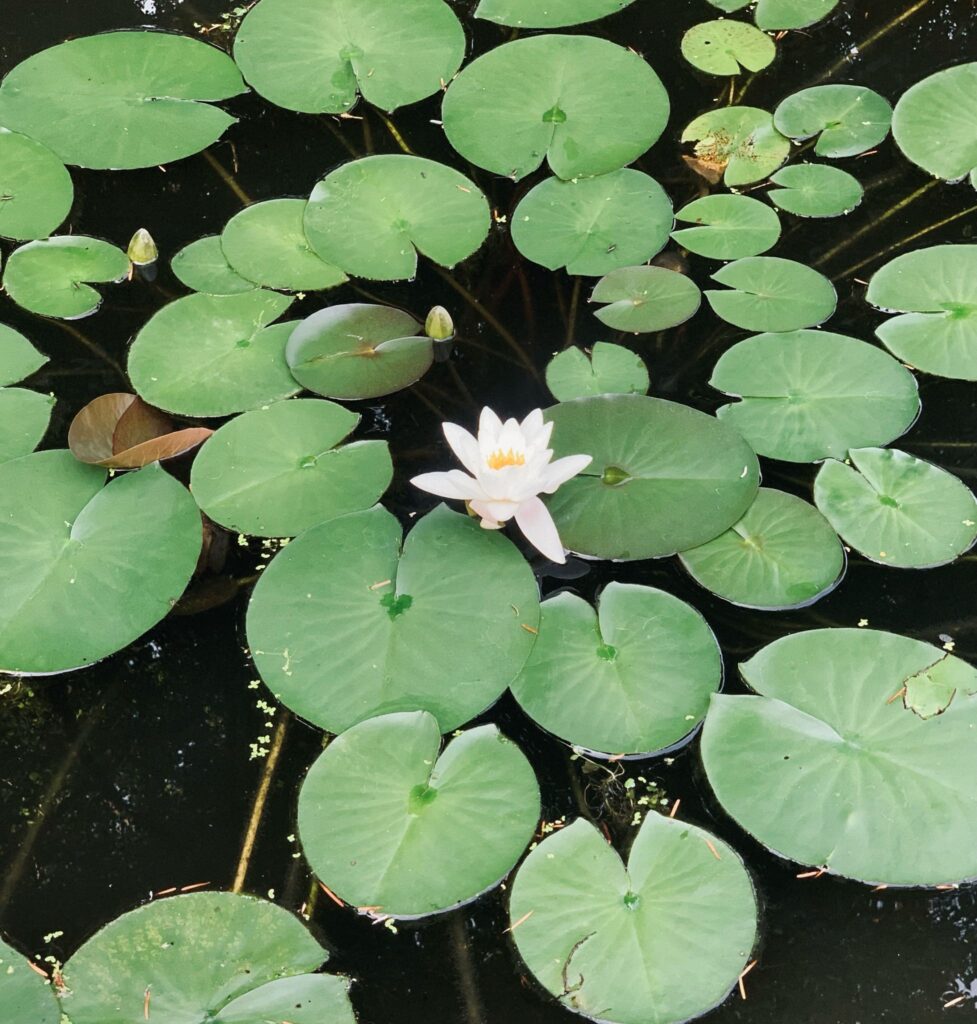
“A single flower floats among lotus leaves, like a quiet whisper over dark water.” by Ágata
Transcendence: the key for giving meaning to life. In the doctor’s words, it allows us to see life as a path of evolution. “We are not our doings or our possessions. We are transcendence,” he affirmed. This approach invites us to leave behind the superficial priorities of the ego and focus on discovering the true “Being.”
Tosin Sanusi ponders over this issue: “in the realm of spirituality, sensitivity comes in handy. HSPs have the innate ability to pick up on subtleties others miss, and looking beyond the material facilitates transcendence. Most spiritual traditions provide a refuge for HSPs, where their loving, compassionate, and giving natures are cherished…”
The spiritual world represents a core part of our identity with lots of thoughtful insight to which we undoubtedly dedicate time and consideration. There is definitely a strong connection between Highly Sensitivity and Spirituality. We, HSPs, give almost every action in life a sacred meaning and we enjoy every little piece of life turning it into a sacred, significant eternal moment.
[1] Patanjali, -an ancient Hindu mystic, philosopher and author- who left us a series of aphorisms in his work “The Yoga Sutras”, considered as one of the two or three most important texts in the field of yoga.
- S Prev
- s
Got something to say?